

Updated November 2026
The UK landline switch off date is 31 January 2027. On that date Openreach closes the old copper PSTN network, and every landline must run over the internet instead. BT says more than 95% of its landline customers had already moved to Digital Voice by September 2026. Your number can stay the same, but some alarms, card machines and fax lines will stop working.
This guide explains what is happening, what breaks, and the three realistic ways to keep a business landline number: Digital Voice, a VoIP or virtual landline, or forwarding to mobile.
What is the PSTN switch off?
The Public Switched Telephone Network (PSTN) is the analogue system that has carried UK phone calls for decades. It uses copper wires and old exchange equipment that is getting harder to repair. Openreach, which runs most of the UK's phone lines, is retiring it and moving every line to digital, internet-based calling.
The switch off was originally planned for the end of 2025. BT pushed the date back in 2024 to 31 January 2027, and Openreach has said publicly that there will be no further extension. The UK government guidance page "Moving landlines to digital technologies" on GOV.UK covers the same programme.
Removing the physical copper is a separate, slower job that will take years. What ends in January 2027 is the analogue calling service that runs over it.
How far along is the switch off?
According to figures BT shared in September 2026 and reported by ISPreview, over 95% of BT's landline phone users have moved to its Digital Voice service. In March 2026 BT said more than three million households had made the move. IT Brief UK reported that around 80% of BT's private and public sector customers had moved their voice services to digital, which is a separate measure.
The remaining lines are the hardest ones: people who have not responded to letters, sites with complex equipment, and premises where an alarm or lift line depends on the old network.
What happens if I have not switched by 31 January 2027?
Openreach has said there will be no "big bang" on 1 February 2027. ISPreview reports that most home customers who have not moved will be placed on a temporary Emergency Voice Access (eVAC) product, which keeps basic calling working while the move is finished.
Business lines do not get eVAC protection. A business still on an analogue line risks losing service, along with anything plugged into it: payment terminals, alarm diallers and emergency lift phones. If you run a business, treat 31 January 2027 as a hard deadline.
What stops working when the landline goes digital?
A normal phone call works fine over a digital line. The trouble is equipment that uses the line to send data, or that draws power from it. BT lists these as the devices to check:
- Burglar and fire alarms that dial a monitoring centre over the phone line.
- Telecare and personal alarms, such as pendants used by older or disabled people. This is the group BT and Openreach treat as most at risk.
- Card machines and payment terminals that connect over a phone line rather than broadband or a SIM.
- Lift emergency phones, door entry systems and gate intercoms.
- Fax machines, franking machines and some CCTV or building-management systems.
- Phones powered by the line, which may not work in a power cut once the line is digital.
For each device, ask the supplier one question: "Is this compatible with a digital line, and if not, what is the replacement?" Many now use a SIM or broadband connection instead.
What should a business do before the deadline?
- List every line you pay for. Old bills often show lines nobody remembers: a fax line, an alarm line, a lift line.
- Find out what is plugged into each one. Walk the building. Check the alarm panel, the till, the lift and the entry system.
- Decide which lines you still need. A forgotten fax line can simply be cancelled. Your main business number should be kept.
- Choose a digital replacement for your main number. See the comparison below.
- Move the number, test it, then cancel the old service. Never cancel first, or you can lose the number.
Digital Voice vs VoIP virtual landline vs mobile: which should you choose?
There are three common ways to replace an analogue business line. They suit different businesses.
| BT Digital Voice | VoIP / virtual landline | Mobile only | |
|---|---|---|---|
| Keeps your landline number | Yes, automatically | Yes, by porting it | No (needs forwarding or a virtual number) |
| Where you answer | Phone plugged into the router at the premises | Browser, app, desk phone or forwarded to any phone | Your mobile |
| Works away from the office | No | Yes | Yes |
| Several people on one number | Limited | Yes, with routing and shared inbox on team plans | No |
| Needs broadband at the site | Yes | Any internet connection, including mobile data | No |
| Best for | Homes and single-site users happy with a desk phone | Small businesses and remote or mobile teams | Sole traders who never need a landline number |
Digital Voice is the simplest choice if you have one office, one phone, and you are happy with BT. Your provider moves you and your number stays the same. Other broadband providers have equivalent digital home phone services.
A VoIP or virtual landline is better when you want the number to follow you, or when more than one person answers it. Calls reach a web app, a mobile app or a desk phone, and you can route them by time of day or to the next available person.
Mobile only is cheapest if you do not care about a landline number, but customers often trust a local geographic number more than an 07 mobile number.
How do I keep my landline number?
UK geographic numbers, such as 020 for London or 0161 for Manchester, can be moved between providers. This is called porting. You keep the number your customers already know, and only the service behind it changes.
The steps are usually:
- Open an account with the new provider.
- Submit a port request with a recent bill from your current provider, so the account name, address and number match.
- Keep the old line active until the new provider confirms the port is complete.
- Test inbound and outbound calls, then cancel the old service.
LimePhone handles UK number porting. See how to switch your number to LimePhone for the details and what to have ready.
If you are starting fresh or opening a new location, you can get a new local number instead. Our guide to getting an 020 London number explains how London numbers work.
How LimePhone works as a virtual landline for UK businesses
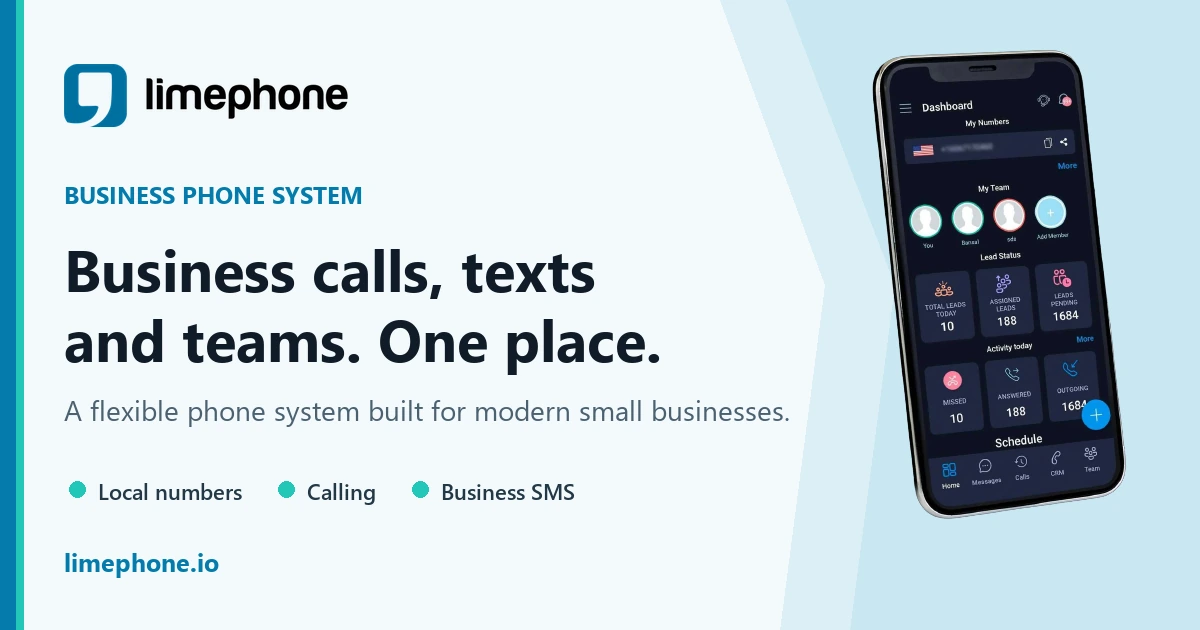
LimePhone is a cloud business phone system. A virtual landline for the UK gives you a local UK number, or your ported existing number, that you answer in a web browser, on the Android app or on any SIP desk phone.
- Every plan includes one UK, US or Canada number, plus call forwarding to any phone, voicemail transcription and a built-in contact list with call history.
- Calls and texts to UK, US and Canada numbers are unlimited, subject to the fair usage policy. Inbound calls are unlimited.
- The Starter plan adds a shared call and text inbox, an auto attendant with call routing, AI call summaries and team analytics.
- If nobody can pick up, an AI receptionist add-on can answer, take messages and pass on urgent calls.
Plans are billed in US dollars. Lite costs $9 a month for one user, Starter is $19 a month with three users, and Growth is $49 a month with five users. Annual billing lowers the monthly cost. There is no contract.
When LimePhone is not the right fit: if you have a single office with one desk phone and no plans to change, staying on Digital Voice with your broadband provider is simpler. LimePhone also does not replace alarm, lift or card-machine lines. Those need a device-specific fix from the supplier.
Ready to move your business number?
If your business line is still analogue, move it well before 31 January 2027. Compare LimePhone plans or start on Lite for $9 a month and port your number once your account is set up.
Frequently asked questions
When is the UK landline switch off?
The analogue PSTN network is due to close on 31 January 2027. Openreach has said there is no extension to that date. Some providers set earlier dates for individual customers, so check any letter you receive.
Will my phone line just go dead on 1 February 2027?
For many home customers, no. ISPreview reports that most consumers who have not moved will be placed on a temporary Emergency Voice Access (eVAC) service. Business lines do not get that protection, so a business that has not moved risks losing its line.
Can I keep my landline number after the switch off?
Yes. Digital Voice keeps your number automatically, and you can also port a UK geographic number such as an 020 or 0161 number to a VoIP or virtual landline provider. Keep your current service active until the port completes.
Will my burglar alarm or card machine still work?
It depends on the device. Older alarms, card terminals, franking machines and fax machines that dial over the analogue line may fail on a digital line. Ask the device supplier whether it is certified for Digital Voice or needs a SIM or broadband upgrade.
Do I need a new phone?
Not always. With BT Digital Voice, most phones plug into the router instead of the wall socket. With a virtual landline you can use a browser app, an Android app, a SIP desk phone or forward calls to your mobile.
Does a virtual landline work in a power cut?
Only while the device and internet connection have power. A mobile app on a charged phone keeps working over mobile data, which is one reason many businesses forward their landline number to mobiles. Anyone who relies on a landline for emergencies should ask their provider about a battery backup.


