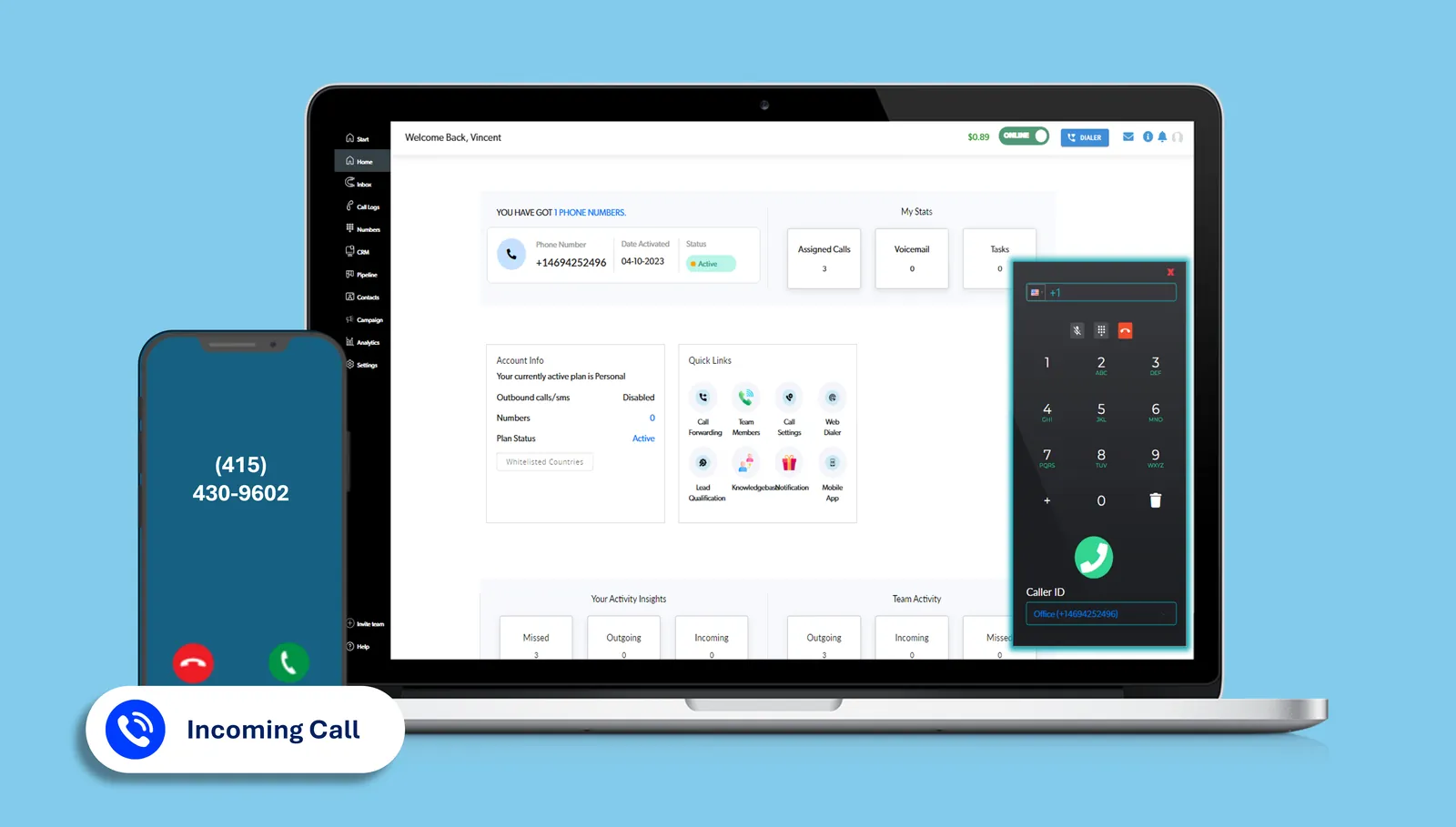
You can make phone calls directly from your computer using a calling app or a VoIP service — a microphone, speakers, and an internet connection are all you need. Below are the best ways to call from a laptop or desktop, and the apps to use for personal and business calls.
Making business calls from a mobile phone all day is tiring, and it splits your work across two devices. Calling from your computer keeps you at your keyboard, lets you take notes while you talk, and works anywhere you have an internet connection. This guide explains how computer calling works, exactly what you need to set it up, and which apps are worth using — plus fixes for the most common call-quality problems.
Can I make phone calls from my laptop without a phone?
Yes. If you use a VoIP calling app that comes with its own virtual number, your laptop is the phone — no SIM card or mobile handset is required. The app carries your call over the internet, and the person you dial sees a regular phone number and answers a normal call. Services like LimePhone work this way: you claim a US or UK number and make or receive calls straight from your web browser.
The exception is phone-pairing apps such as Microsoft Phone Link and Apple's FaceTime. These use your existing mobile number, so they need your phone nearby and paired to work. That's convenient for personal calls, but it ties your business calling to one personal device and one personal number.
What do you need to make calls from a computer?
Here's the full checklist — most laptops already tick every box:
- A stable internet connection: Wi-Fi, Ethernet, or a mobile hotspot all work. The Federal Communications Commission (FCC) lists a download speed of under 0.5 Mbps as sufficient for VoIP calls — a single voice call uses roughly 100 kbps — so nearly any broadband connection has enough bandwidth.
- A microphone and speakers: Built-in hardware is fine for basic calls. A USB or Bluetooth headset with noise canceling noticeably improves clarity on both ends.
- A calling app or VoIP service: Free consumer apps handle personal calls; a business phone system adds features like shared numbers, auto-replies, and call recording.
- A phone number: Either your existing mobile number (via a pairing app) or a virtual number from your VoIP provider.
- Microphone permission: Your browser or app must be allowed to access the mic in your computer's privacy settings — the most common reason a first call is silent.
What's the difference between a VoIP call and a regular phone call?
A regular call travels over the cellular network or a landline, which ties it to a SIM card or a physical line in one location. A VoIP call converts your voice into data packets and sends them over the internet — the connection you already pay for — then hands the call off to the regular phone network, so the other person's phone rings normally. For the person you're calling, there's no difference at all: they see a normal number and answer a normal call.
Three practical consequences follow. Cost: because the call rides your existing internet connection, VoIP providers charge far less than legacy phone plans — no line rental, no long-distance surcharges. Portability: your number lives in the cloud, so any device you sign in on — laptop, tablet, or phone — becomes your business phone. Quality: call clarity depends on your internet connection rather than your distance from the other caller, which is why a quick speed test matters more than geography.
How to make a phone call from your computer (step by step)
1. Check your internet connection
Computer calls rely on a stable connection. Wi-Fi is the most common option, but a wired Ethernet connection or a mobile hotspot works too. You don't need lightning-fast speeds — per the FCC, under 0.5 Mbps download is sufficient for VoIP — but to avoid jitter (audio interruptions), run a quick internet speed test before your first call. Stability matters more than raw speed.
2. Choose a calling app or business phone system
Many providers offer desktop or web apps that let you make and receive calls directly from your computer. Popular free apps like FaceTime or WhatsApp can place calls, but they lack the business features that matter for customer conversations — auto-replies, shared numbers, and CRM integrations are typically unavailable. Pick a consumer app for personal use and a business phone system for work.
3. Set up your microphone and speakers
Most computers ship with a built-in mic and speakers, so you may already have everything you need. For a better experience, consider a quality VoIP headset: it improves incoming audio and its noise-canceling mic filters out background distractions, so you can confidently take calls from a busy office or coffee shop.
4. Select the right audio devices
Whether you use a Bluetooth, USB, or wired headset, double-check that it's securely paired or plugged in, and verify that your external microphone is selected as the primary input device in your computer's sound settings. An unselected mic is the number-one cause of "can you hear me?" moments.
5. Place a test call
With your connection, app, and audio ready, launch the app and dial a test number — a colleague or your own mobile. Listen for echo, delay, or dropouts before you take an important call.
How to make a call from your web browser (no downloads)
If you'd rather not install anything, browser calling is the fastest route — here's the whole flow with a service like LimePhone:
- Sign in to your account in Chrome, Safari, or Edge.
- Allow microphone access when the browser asks — this prompt appears once per site, and calls will be silent if you dismiss it.
- Click the call icon in your workspace, type the number (or pick a contact), and click to dial.
- Talk through your headset or built-in mic — the call connects over the internet and rings the other person's phone normally.
- Keep the tab open if you're expecting calls back; incoming calls ring right in the browser.
Because nothing is installed, this works the same on any computer you sign in from — your office desktop, your laptop at home, or a borrowed machine while traveling.
What headset and audio setup should you use for business calls?
You can start with built-in hardware, but if you're on calls daily, a modest audio upgrade pays for itself in fewer repeats and clearer conversations:
- Wired USB headsets are the reliability pick — no battery, no pairing, no interference. Ideal for a fixed desk.
- Bluetooth headsets buy you freedom to stand and move, at the cost of charging and occasional pairing quirks. Re-check the input device after each reconnect.
- Noise-canceling microphones matter more than fancy speakers: they strip out keyboard clatter and background chatter so you sound professional from anywhere.
- Whatever you choose, confirm it's selected as both input and output in your sound settings, and do one test call after any hardware change.
How to make calls from your computer with LimePhone
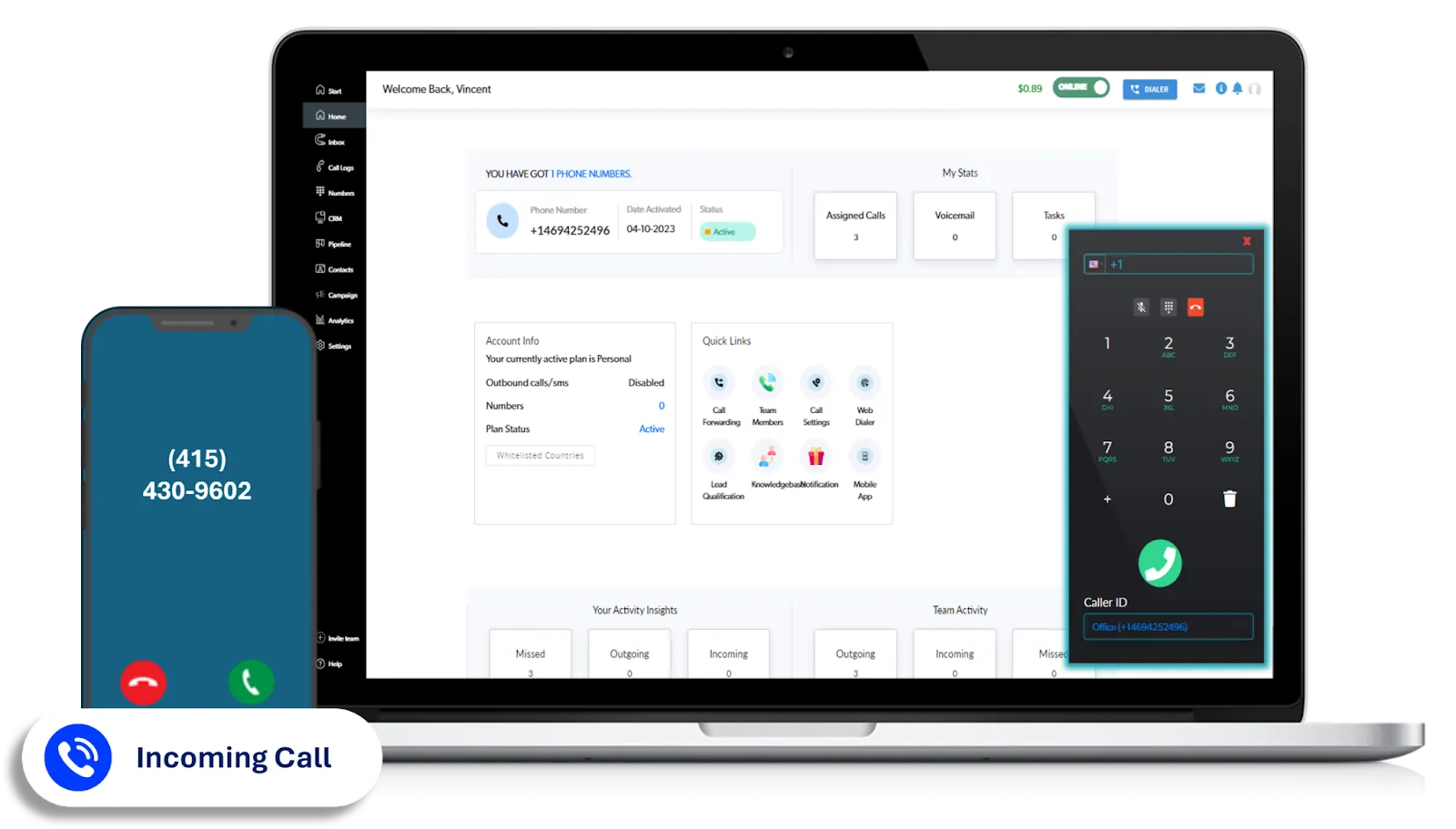
LimePhone turns your computer into a full business phone. It works the same on PC and Mac because it runs in your web browser — no install required — and it lets you place calls and send texts from one workspace. You can import your existing contacts, and once they're synced, a single click starts a call.
Three ways to place a call in LimePhone
- Direct dialing: Need to call a number that isn't saved in your contacts? Open your workspace, click the call icon, type the number, and click to connect.
- Calling from contacts: Open your contact list, select the person you want to call, and tap the call icon — or use the search bar to find a contact and call directly.
- In-thread calling: Already texting with someone? Open the conversation thread and click the call icon to switch the conversation to voice without losing context.
How to set up LimePhone in minutes
- Start a free trial: Create an account on LimePhone — signup takes a few minutes and the trial lets you explore every feature.
- Claim your virtual number: Get a US or UK phone number (numbers in 40+ countries are available), choose a toll-free number for broader reach, or port an existing US or UK number you already own.
- Activate your account: LimePhone's team verifies your account with a quick phone call — then you're all set.
Keep work and personal calls separate
Because your LimePhone number is separate from your mobile number, it works as a second phone number for work. You keep a clear professional image with customers while your personal number — and your personal life — stays private.
How to make phone calls from a Windows laptop
Windows users have three solid routes, depending on whose number you want the call to come from:
- Use a browser-based VoIP service: Sign in to a service like LimePhone in Edge or Chrome, claim a virtual number, and call directly from the web app. There's nothing to install, no phone needs to be nearby, and the number is a dedicated business line rather than your personal one.
- Pair your phone with Phone Link: Microsoft's Phone Link app connects your Android phone or iPhone to a Windows 10 or 11 PC, so you can make and answer calls on your existing mobile number from your desktop — incoming calls appear as a pop-up you can answer or decline.
- Use Google Voice in a browser: US-based users can call from Google Voice's free tier through the browser or its Chrome extension — with the call-quality and support caveats covered later in this guide.
How to make phone calls from a Mac
Mac users get the same three-way choice, with FaceTime taking Phone Link's role:
- Use a browser-based VoIP service: Browser apps like LimePhone run identically in Safari or Chrome on macOS — the best route when you want a separate business number that never touches your personal line.
- Use FaceTime: FaceTime on a Mac places audio and video calls on your personal number and can start calls straight from phone numbers listed on webpages. It's exclusive to Apple devices, though, so contacts on Android can't call you back the same way.
- Use Google Voice in a browser: It behaves the same on macOS as on Windows, since it's entirely browser-based.
How much does it cost to make calls from a computer?
Free options exist, with trade-offs: Phone Link and FaceTime cost nothing but run on your personal number, and Google Voice's free tier is US-only with no dedicated support. A business VoIP plan is the low-cost middle ground. LimePhone's basic plan is $4.99 per month and includes:
- A local US or UK phone number to build a professional local presence
- 250 local calling minutes per month for outbound calls
- Unlimited incoming calls, so you never miss an inquiry
- One user account — ideal for solopreneurs and small teams
- Slack integration to receive calls and SMS inside your workspace
- 40+ features including call recording, a centralized SMS inbox, and voicemail transcription
- Free call forwarding, auto-replies, and a basic IVR (Interactive Voice Response) menu
Compare plans on the LimePhone pricing page — you can start on the cheapest tier and upgrade only when your call volume grows.
As a rule of thumb: if you just want your personal calls at your desk, a free pairing app is enough. If you're calling customers, a paid VoIP plan earns its few dollars a month immediately — you get a separate business number, team access, recording, and forwarding, and you stop handing your personal mobile number to strangers.
Why make business calls from a computer?
1. Better collaboration and streamlined workflows
Imagine multiple team members answering and making calls on the same phone number, each from their own computer. LimePhone makes this a reality, eliminating the risk of missed calls and creating a genuinely collaborative calling environment. Activate call transcriptions and every conversation is automatically recorded and transcribed — revisit calls for reference, spot patterns, and coach your team on real customer interactions.
The integrations complete the picture: LimePhone connects with Slack, HubSpot, and Salesforce, so customer conversations are tracked inside the tools your team already lives in. No app-switching, no copy-pasting call notes.
2. Lower costs than traditional phone service
Traditional phone services are a significant drain on business budgets. VoIP calling and texting cost significantly less per month than legacy phone plans, and there are no ongoing maintenance or installation fees to contend with. Flexible plans let you start with a cost-effective option and scale up as your needs evolve — you only pay for the features you actually require.
3. Multitask while you talk
When the call happens on the same screen as your work, your team is no longer tethered to a handset with no access to information. They can pull up past conversations, project documents, and customer details mid-call — a support rep can reference a client's purchase history or project notes while the client is still talking, resolving issues in one conversation instead of three. That level of context is simply impossible on a traditional phone call.
How to choose a computer calling app
Before comparing individual apps, decide what you actually need — the right choice falls out almost automatically:
- Whose number will you call from? Pairing apps (Phone Link, FaceTime) use your personal mobile number; VoIP services give you a separate number. For business, a separate line protects your privacy and looks more professional.
- Which platforms does your team use? Phone Link is Windows-only and FaceTime is Apple-only. Browser-based services are the only option that works identically for everyone.
- Do you need business features? Shared numbers, auto-replies, call recording, voicemail transcription, and IVR menus only exist on business phone systems — no free consumer app offers them.
- Do calls need to reach your other tools? If customer conversations should appear in Slack or your CRM, check integrations before you commit; consumer apps have none.
- What's the total cost? "Free" apps are free because they piggyback on your existing phone plan or show ads. Compare the monthly price of a VoIP plan against what missed calls and a personal-number business presence cost you.
What are the best apps to make calls from a computer?
Beyond LimePhone, four widely used apps let you call from a laptop or desktop. Here's what each does well, where it falls short, and what it costs.
Phone Link

Phone Link connects your Android phone or iPhone to a Windows 10 or 11 PC. Getting started is a breeze: download the app on both your desktop and your mobile phone, pair them, and your devices are linked. From then on you can use your existing phone number from your computer — incoming calls show a desktop pop-up you can answer or decline, and you can place calls without picking up your phone.
The limitations matter for business use, though. Phone Link excels at basic calling but lacks functionalities like shared numbers, which are crucial for team collaboration, and it doesn't integrate with CRM software — so customer data stays out of your workflow.
Pros:
- Effortless setup — pairing phone and PC is smooth and user-friendly
- Works with both Android and iOS
- Completely free, with no hidden fees or subscriptions
Cons:
- No business features like shared numbers
- No third-party or CRM integrations
- No call recording or transcription
Key features:
- Making and receiving calls using your existing phone number
- Viewing incoming call notifications on your PC
- Answering or declining calls with a desktop pop-up
Pricing: Phone Link is completely free, with no hidden fees or subscriptions.
Verdict: A great free choice for taking personal calls at your desk. If you need shared numbers, integrations, or recording for business use, look elsewhere.
FaceTime

FaceTime is the default calling app for Apple users, handling both audio and video calls from a Mac. Like Phone Link, it uses your existing personal number, and it can conveniently start calls from phone numbers listed on webpages. The catch for business use: it's exclusive to Apple devices, so Android users can't initiate FaceTime calls, and there's no way to separate business from personal communication.
Pros:
- Seamless integration across Apple devices
- Click-to-call from numbers on webpages
- Free video calling built in
Cons:
- Tied to your personal number — no separate business line
- No shared numbers or team features
- No business tool integrations, and no calls from Android users
Key features:
- Audio calls using your existing phone number
- Video calls to connect face-to-face
- Click-to-call from phone numbers listed on webpages
Pricing: FaceTime is pre-installed on Apple devices and completely free.
Verdict: Free and excellent for staying in touch with friends and family on Apple hardware. Not built for business calling.
Skype

2026 note: Microsoft retired Skype in May 2025 and pointed users toward Microsoft Teams, so Skype is no longer an option for new setups — we keep it here because so many people still search for it, and to show what to look for in a replacement.
Skype's appeal was free voice and video calls between Skype users, plus the option to buy up to 10 local phone numbers per account. Its weaknesses are instructive when choosing an alternative: calls to regular landlines and mobiles cost extra (per-minute or subscription), text messages couldn't be scheduled, and you couldn't port your existing phone number onto the platform.
What to take away: If you relied on Skype for cheap computer calling, a VoIP service with its own number — and porting support, so you keep your number if you ever switch — is the closest modern replacement.
Google Voice

Google Voice offers both a free tier and a paid business product. The free Google Voice number lets US-based users call from a computer at no cost, but call quality complaints are common and there's no dedicated customer support. The paid version, Google Voice for Google Workspace, is a proper VoIP solution for Windows and Mac — there's no desktop app, but it runs in any browser and has a Chrome extension. It includes free calls to US numbers (and Canadian numbers for US users), voicemail transcription, and business-hours call routing. It lacks auto-replies and toll-free numbers, and integrations are limited to other Google Workspace apps.
Pros:
- Free US calls on the free tier (with quality and support caveats)
- Seamless integration with Google Workspace tools
- Shared call responsibility on paid plans
Cons:
- No auto-replies or toll-free numbers
- Integrations restricted to Google Workspace apps
- Requires a paid Google Workspace account (from $6/month) on top of the Voice subscription — two services to pay for
Key features:
- Free calls to US-based numbers, with limitations (free tier)
- Voicemail transcriptions (Google Voice for Google Workspace)
- Business hour settings for call routing (Google Voice for Google Workspace)
- Shared call responsibility (paid upgrade)
- Browser access plus a Chrome extension for calling
Pricing: The free tier serves US-based users with limitations. The business product requires a paid Google Workspace account (starting at $6 per month) in addition to the Google Voice for Google Workspace subscription — two services to budget for.
Verdict: A reasonable free option for US users who can live with the caveats. For business use, weigh the dual-service cost against dedicated VoIP providers.
Common problems when calling from a computer (and how to fix them)
Nobody can hear you on the call
Almost always one of two things: your external microphone isn't selected as the input device (fix it in your computer's sound settings), or your browser is blocking microphone access (check the site permissions next to the address bar). Check both before reinstalling anything — hardware failure is the rare cause, not the common one.
Choppy, robotic, or cutting-out audio
That's jitter — packets arriving unevenly. Run a speed test, move closer to your router or switch to a wired Ethernet connection, and pause large downloads or video streams during calls. Remember: a voice call only needs about 100 kbps, but it needs it consistently. If the problem persists on a shared office network, calls may be competing with other traffic.
Echo on the line
Your microphone is picking up sound from your speakers and sending it back. Switching to a headset — any headset — eliminates the loop instantly. If the echo is on the other person's end, it's their setup, not yours.
Incoming calls don't ring on your computer
Keep the calling app or browser tab open, allow its notifications, and check that your operating system isn't in do-not-disturb or focus mode. As a safety net, set up call forwarding to your mobile so calls still reach you during the hours you're away from your desk.
Too much background noise
A noise-canceling headset microphone filters out office chatter and coffee-shop clatter on your end — the single biggest upgrade for anyone taking business calls outside a quiet room.
Which computer calling app should you use?
The short version, matched to your situation:
- You're on Windows and just want your personal calls at your desk: Phone Link — free, easy pairing, uses your existing number.
- You're all-Apple and calling friends and family: FaceTime — free, pre-installed, adds video.
- You're US-based and want free above all: Google Voice's free tier — accept the call-quality and support trade-offs.
- You're calling customers, on any platform: A browser-based VoIP service like LimePhone — a separate business number, shared team access, recording, forwarding, and CRM/Slack integrations, from $4.99 per month.
- You used to rely on Skype: A VoIP service with number porting is the closest modern replacement now that Skype is retired.
Making calls from a computer FAQs
Can I make a phone call from my laptop for free?
Yes, within limits. Phone Link (Windows) and FaceTime (Mac) are free but route calls through your personal mobile number. Google Voice's free tier allows free US calls with quality caveats. App-to-app calls (WhatsApp, FaceTime) are free anywhere; calling regular landlines and mobiles usually requires a paid VoIP plan — which starts at just a few dollars a month.
Do I need a SIM card to call from a computer?
No. A VoIP number lives in the cloud, not on a SIM, so any device with an internet connection and a microphone can use it. Only phone-pairing apps like Phone Link need a physical phone nearby.
Can I use my existing phone number on my computer?
Two ways: pair your phone with an app like Phone Link so calls to your mobile number appear on your PC, or port your number to a VoIP provider — LimePhone supports porting existing US and UK numbers — so it works natively from any browser.
Can people call me on my computer?
Yes. Incoming calls ring in your calling app or browser tab just like on a phone, and LimePhone's basic plan includes unlimited incoming calls. Free call forwarding ensures calls still reach you on another device when you step away.
Does computer calling work on both Windows and Mac?
Browser-based VoIP services like LimePhone work identically on PC and Mac. Phone Link is Windows-only, and FaceTime is exclusive to Apple devices — so a browser-based service is the safest choice for mixed teams.
How much internet speed do I need for VoIP calls?
Very little. The FCC lists under 0.5 Mbps download as sufficient, and a single call uses roughly 100 kbps. What matters more is stability — low jitter and packet loss — so a wired connection or strong Wi-Fi signal beats raw speed. Run a speed test before your first important call.
Can I send text messages from my computer too?
Yes — business VoIP platforms treat texting as a first-class feature. LimePhone includes a centralized SMS inbox, lets you text from the same browser workspace you call from, and can forward SMS into Slack, so a customer's whole conversation lives in one place.
Can I make international calls from my computer?
Yes. Because a VoIP call travels over the internet, distance doesn't change how it works — you dial an international number exactly like a local one, and rates are typically far below carrier prices. LimePhone offers numbers in more than 40 countries, so you can even hold a local number in the countries you call most.
Can I record calls made from my computer?
On a business VoIP service, yes — LimePhone includes call recording and transcription even on its basic plan, which is useful for reference, training, and dispute resolution. One caution: call-recording consent laws vary by state and country, so tell participants they're being recorded. Free apps like Phone Link and FaceTime don't offer recording.
Do I need to install software to call from my computer?
Not necessarily. Browser-based services like LimePhone run entirely in Chrome, Safari, or Edge — you sign in and dial. Pairing apps like Phone Link require an install on both your PC and your phone, while FaceTime comes pre-installed on Macs.
Will the person I call see a real phone number?
Yes. Calls from a VoIP service show your virtual number on the recipient's caller ID — a normal US or UK number they can save and call back — and calls through pairing apps show your existing mobile number. Nobody sees "internet call" or "unknown"; it looks like any other call.
Can I use the same number on my phone and computer at the same time?
Yes — that's one of the biggest advantages over a SIM-based number. Because the number lives in the cloud, it rings every device you're signed in on: answer at your desk during the day, from your mobile after hours, and the caller never knows the difference.
Can I make calls from my computer without internet?
No — VoIP calls need an internet connection, since the internet is what carries the call. If your connection drops, a mobile hotspot will carry voice calls easily (remember, a call needs only ~100 kbps), and call forwarding to your mobile keeps you reachable in the meantime.
Why LimePhone Stands Out in the Computer Calling Arena

Calling from your computer means you can answer, dial, and manage conversations without ever reaching for your phone. LimePhone goes further than basic calling: it's a complete communication hub where texts and calls for your business live on one platform, and it works from any device — laptop, tablet, or mobile — so you stay connected wherever you are.
Sign up today and see how much smoother business calling feels when it happens right on your computer — with a free trial, there's nothing to lose.